
Table of Contents
-
Introduction
-
Pre-Installation Checklist
-
Android Screen Sync Setup Guide
-
Post-Installation Support
-
FAQ & Troubleshooting
What Is Screen Sync?
Screen Sync is a feature that allows multiple digital signage devices to display content at the exact same time. This is especially useful for video walls, multi-screen installations, or any environment where synchronised playback creates a seamless viewing experience.
With Screen Sync, one device acts as the Master, coordinating playback instructions and ensuring all other connected devices remain perfectly aligned. This process happens automatically over the local network, providing smooth and reliable synchronisation without the need for additional external hardware.
⚠️ IMPORTANT INFORMATION ⚠️
App Version 5.3.31+
📌 This is the new best practice method for Screen Sync. Customers on app version 5.3.31 or above should follow this approach.
In version 5.3.31, Screen Sync support has been extended to multizone layouts. The new standard approach uses a single playlist combined with the platform's tagging functionality to deliver the correct content to the correct screens — no separate playlists per screen required.
How it works:
- Create a single playlist containing all content required across your synced screens.
- Use the Tag Manager to tag relevant content items and screens. This tells the platform which content should display on which screen. See the guide: Tag Manager — Setting Up Targeted Tags
- Add the screens to a Sync Group within the Screen Sync app
- Reboot all devices to activate the sync.
How Users Can Benefit From Screen Sync.
Users can create synchronised content experiences by grouping screens together within the NowSignage platform. Once the desired screens are added to a Sync Group and the devices are rebooted, Screen Sync takes care of the rest. The system continuously ensures that each device stays in sync with the Master device, maintaining consistent playback across all screens.
Screen Sync is ideal for:
- Multi-screen video displays
- Retail environments requiring unified visual messaging
- Corporate or event spaces with coordinated screens
Multi-Zone Sync Support:
Support has been added for synchronising playback across multiple zones within a layout.
Key behaviour:
- Ensures content plays in sync across all zones on a screen
- Requires each zone to contain the same number of items
- Requires matching item durations across all zones
This enables more coordinated and visually aligned multi-zone experiences.
Android Screen Sync Setup Guide
Preparing Your Screen Sync Setup
- Log in to your NowSignage account and create any required screens, schedules, and playlists.
Screens with only one playlist item will cause the sync server to stall, resulting in playback drifting out of sync. Additionally, the second copy of the content should be renamed in the CMS, for example “Video” and “Video (2)”, to allow consistent playback across screens.
- Navigate to the Apps section and select the Screen Sync app.
- Click + Add Sync Group (top-right corner) and assign a name to the group.
- Add the screens to be included in the sync group by selecting them from the list.
Additional Settings
- Re-Sync Interval:
- This setting is not required when using the latest app version referenced in this guide.
- Websocket Server Address:
- This field is required when using Android Devices. To retrieve this you must install the RDM app, please see step 1 below for details on how to obtain the IP.
- This field is required when using Android Devices. To retrieve this you must install the RDM app, please see step 1 below for details on how to obtain the IP.
Once the group has been configured, reboot all the associated devices to complete the setup.
Tip: The first screen/device added to the sync group automatically becomes the Master. The master is responsible for issuing internal playback commands to all other (child) screens, whose clocks are paused and driven by the master's instructions.
Note that the master role (first screen added) is separate from the WebSocket server host, the server can be run on any device in the group, not necessarily the master.
Step 1. Install the Latest Remote Device Management (RDM) application
Android RDM APK:
https://cdn.nowsignage.com/android-rdm/1.0.3.apkAfter installation, open the RDM application on one device and enable the WebSocket Server option. - The device with the enabled WebSocket server becomes the master device in the sync setup and will send sync commands to all other devices in the group.
Note: Only the one 'master' screen needs to have the 'enable websocket server' option enabled. - All other devices required for the sync group require the RDM installation but can be left unchecked.
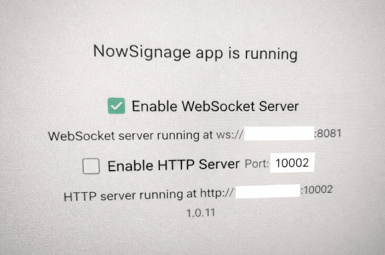
⚠️ The HTTP server does not need to be enabled for standard configurations.
Once enabled, the application will display the server’s IP address.
This information must be noted, as it is required when configuring the sync group in the NowSignage CMS. - Sync group setup cannot be completed without implementing this step.
Step 2. Install the Latest NowSignage Android APK:
Android Operating System:
https://cdn.nowsignage.com/android/5.3.41.apk
KB Article: https://knowledgebase.nowsignage.com/installing-the-latest-nowsignage-android-apk
Step 3. Configure the Sync Group in NowSignage:
- Log in to the NowSignage account.
- Navigate to Apps on the left-hand menu.
- Select the Screen Sync app.
- Click + Add Sync Group in the top-right corner and assign a name to the group.
- Add the required screens to the group by selecting them from the 'Available Screens' area.
⚠️ Important: Screen Sync requires at least two assets in a playlist.
Screens with only one playlist item will cause the sync server to stall, resulting in playback drifting out of sync. - It is possible to use the same asset twice; however, the second copy of the content should be renamed in the CMS, for example, “Video” and “Video (2)”, to allow consistent playback across screens.
Re-sync Interval:
This option is not required for Android devices running the latest app build referenced in this guide.
In the Screen Sync app configuration, a field labelled WebSocket Server Address will appear. After adding screens to the group, populate this field with the IP address of the master device (the device with the enabled local WebSocket server), followed by :8081.
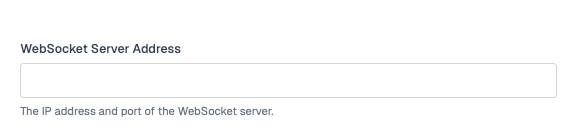
Example: xxx.xxx.x.xx:8081
⚠️ This entry is essential, as port 8081 is used by the WebSocket server.
Once complete, click Update to save the configuration.
4. Reboot Devices
After the setup is finalised in NowSignage, reboot all devices to initiate the sync process.
Verifying Device Connectivity
To verify screen sync, a reboot is required. In both of the following cases, an observer must be physically present in front of the screens:
-
Direct Device Verification: Perform a reboot and then visually confirm that the content is playing correctly and in sync.
-
Support Verification: If the status remains unclear after a reboot, please contact support. We can assist by deploying a specific test feature to the screens and reviewing a photo of the displays to confirm what is being seen.
Firewall & Network Requirements.
Appropriate firewall and network configuration is essential for NowSignage to function correctly. A full list of required domains and ports can be found on the following link:
Screen Sync Local Server Requirements
To ensure successful communication between devices:
- Internal LAN communication be enabled.
- Devices must be allowed to communicate with one another on the same local network.
- Player devices must be reachable on the network.
- Screen sync operates by listening for synchronisation commands on port 8081.
- The local server runs using the device's IP address and this port, allowing seamless interaction between devices.
FAQ & Troubleshooting
FAQ
Q. Screens are not in sync despite being correctly configured
A. Are using app version 5.3.31 or above? - Is your content in a single playlist or multiple? - Please see important information at the top of this guide.
Q. Do all screens in a sync group need to have identical content?
A. NO. However, Screen Sync only works when every screen in the Sync Group has an identical playlist duration.
This includes:
-
The exact same number of assets
-
The same individual asset durations
-
The same overall playlist duration
If any screen has different content timing, the devices will fall out of sync.
If you only want certain screens to sync with each other, you must:
-
Create a separate Sync Group containing only those screens
-
Assign an identical playlist to those screens
Q. Do I need to choose a specific screen as the “Master” device?
In most cases, any screen can act as the master, and playback will still sync correctly.
However, for best performance and stability, we recommend selecting a screen that has:
-
The most reliable network connection
-
Hard-wired Ethernet (LAN) where possible, rather than Wi-Fi
-
A device that is generally considered the most stable or centrally placed in the deployment
While Screen Sync is designed to handle network variations, choosing a strong, stable master device helps maintain consistent synchronisation across the group
Troubleshooting
My screens are not staying in sync
Check the following:
-
All screens in the group have the same playlist structure
-
Asset durations match exactly
-
Total playlist duration is identical across all devices
-
No screen has additional or missing assets
-
The designated master screen has a strong and stable network connection
-
Screens are placed in the correct sync group.
- Verify that the date and time settings on your hardware are consistent across all media players and System on Chip (SoC) screens.
Some screens sync, but others do not
This typically means the non-syncing screens have:
-
Different playlist timings
-
A different number of assets
-
A network issue causing sync drift
-
Been added to the wrong Sync Group
If only specific screens should sync together, create a new, separate sync group for those devices.